Tuesday, September 26, 2017

Amarillo, TX


Amarillo Texas is located in the far north of the Texas panhandle, only 60 or so miles from the New Mexico boarder.  Surrounded by hundreds of miles of flat, dry, (usually) prairie, you would not expect there to be much of interest there.  The main reason we wanted to spend a day or two here was to check out the "Cadillac Ranch".

Having seen pictures of this permanent public roadside sculpture many years ago, it has been on my wish list to see the real deal some day. The location, in itself, is half the fun.


Interstate 40 incorporates a frontage road, that parallels the highway, and allows access to side roads and businesses.  As you drive on this frontage road, you pass  an occasional RV park or side road, but mostly acres and acres of corn fields.

You need a sharp eye to pick out ten tall "things"  off  toward the back of a field where corn had been recently harvested.  We might have missed it if it weren't for the dozens of cars parked by a metal gate opening through a barbed wire fence.  As you can see, it is a distance back from the road, and today it was mud all the way..


Not usually surrounded by water, these ten Cadillac cars were first displayed, half buried in the dirt, back in 1974.  Three young men from an art group called the "Ant Farm"  came up with the idea, somewhat symbolizing the birth and death of the Cadillac tail fin, and  presented it to millionaire Stanley Marsh 3.


Marsh donated the land and became a long time  patron and supporter of the project.  The cars, vintage 1949 thru 1963 were found in junk yards, or as running used cars.


Long since having lost their original colors, and many parts, spray painting graffiti is not only tolerated, but encouraged.  There is a dumpster at the gate for empty cans, but those that are not quite empty after an art project are left for others to use up.  This young lady was totally prepared for the experience, complete with paint, stencil, tape, and mud boots!


Not only the young folks get into the spirit of this interactive art project, this gentleman of 70 years, was having a blast.


Father and daughter (I think), working together.


She painted, he carried her and the paint, so she didn't get wet and muddy


All I did was take pictures.  No spirit of adventure. (Mostly no boots)


The Cadillac Ranch mania has extended to local RV parks.  I thought this was the most clever.


Another RV park has what looks more like how the Cadillac's appeared when they were originally sunk in the mud.


Later that day we picked up a local brochure listing things to see in Amarillo.  One recommendation was the RV Museum.


Turned out to be an extensive collection of old restored camper trailers of all types. Currently the Jack Sisemore Traveland RV Sales and Service establishment is enormous, but according to the published story, he started out buying one RV to use for vacations and to rent out the rest of the year.
It was a 1974 Winnebago and Jack was the first Winnebago dealer in Texas.


The collection includes different styles and models from the 1940's through the 1970's


Each trailer has been restored to original condition or displayed as they were found. They all include a sign giving the details of where they were located, manufacturer, and how much restoration needed to be done.


A classic of the 70's


This 1942 Harley Davidson motorcycle was used in WWll
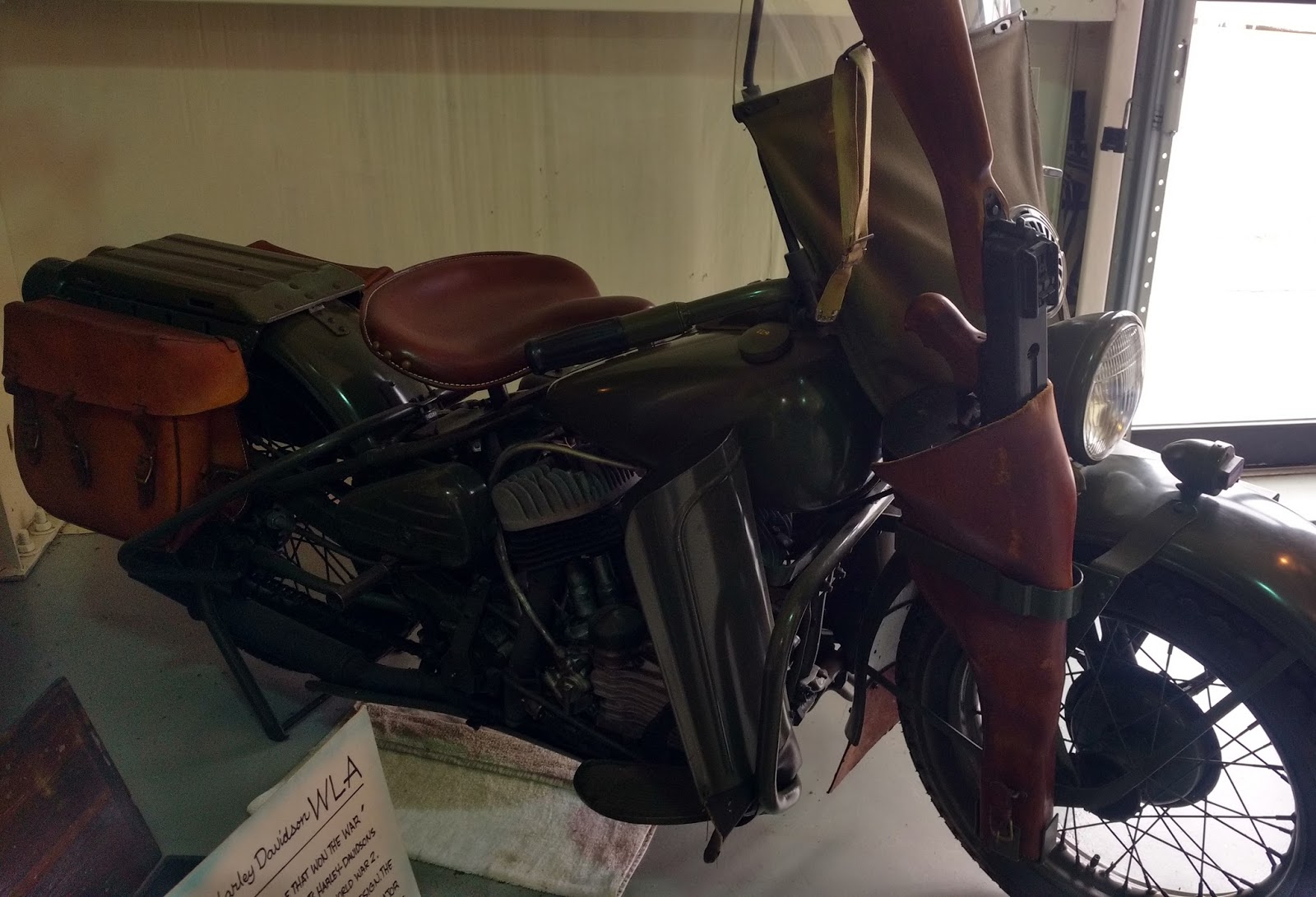


The museum had a very large collection of motorcycles.  This was my favorite.  Great way to spend an afternoon, and there is  no admission charge.


We rounded out the day with an early dinner at THE BIG TEXAN steak house. 


The famous Route 66 passes through Amarillo and although its hay day is long past, the highway still has a mystique, along with many GIANT signs that were popular when the road was the primary route between California and Chicago.


Big Tex and  this larger than life steer are two examples of the roadside attractions on the old Route 66.  Better than billboards, I'd say.


The Big Texan Steak Ranch is known, as the sign says, for the 72 ounce "free" steak


It is free if you can eat the entire steak, baked potato, roll, salad, and the shrimp appetizer, all within one hour's time.  If not it costs you $72.


Those who take the challenge sit at an elevated table with a countdown clock, clicking off the seconds, directly overhead  When we arrived there were two men at the table, with ten minutes left on their clock.  When the timer reached three minutes, they both got up and left, most likely to pay their $72 bill.


My sirloin was 8 ounces and it was all I could do to finish that much.


Another fun day of being a tourist in Amarillo, Texas


Sunday, September 24, 2017

More fishing, new friends, and Eleven Mile Canyon

While I was on a walk Monday morning I spied an interesting kayak rack at the back of someones trailer so I stopped to inquire.  Naturally this called for a detailed description of the construction.


After giving me the run down of how he combined odd pieces of bike rack, PVC pipe, rachet straps, and one secret ingredient, he mentioned that he was here for the fishing.  This opened the door to a speedy friendship with he and his wife.


Barbara and Glen Doran from Tallahassee, FL


Barbara and Glen are from Tallahassee Florida.  They are both retired and travel in a tow-behind camper that they affectionately call the Taj MyHaul.  Needless to say, since her background is journalism, they have fun playing with words.

After quickly establishing their mutual quest for the elusive fish, Glen and Marlin took off every morning at 8:00, lunch and pole in hand, to torment the innocent trout in several different locations.  Barb and I did some walking, but mostly talked about projects, our history, grand children, and life in general.  Lots in common, hope to keep in touch with this fun loving pair.

Several times, the second week we were at Eleven Mile, Glen and Marlin fished in Eleven Mile Canyon where Marlin and I had explored on  non fishing journeys  The catching here was almost as good as the fishing, but the beauty of this location was the best.


This canyon meanders from below the dam that creates Eleven Mile resevouir.  "Bottom water", named because it comes from the base of the dam, is a favorite of trout because of the cold temperature.


The reservoir itself is in an open basin with grassland topography, but the canyon is a lush,  forested, rocky pathway holding the dam outflow of the South Platte.


The narrow, eight mile, dirt road is actually the remains of the Colorado Midland rail line.  It was the first standard gauge railroad built over the continental divide and ran between Colorado Springs and Grand Junction.  It ceased operation in 1918 and the entire line was scrapped by 1920.  The dam was build at the head of the canyon in 1932.


As I walked along the road I noticed several places where large parts of it had washed down the hill.  You can see from the tire tracks that if you veered very close to the edge, you might end up in the canyon below.


The road now runs through three tunnels, blasted from the canyon rock walls for the track bed.  It is hard to believe that they are wide enough or high enough for a locomotive to pass through without scraping the sides and roof.   You can also see that this tunnel is in the middle of a curve.


Two tunnels in a row


Not a lot of wiggle room.


I saw many faces in the rock outcroppings.  What do you think?


Long nose, popped out eye.


The river makes a serene exit after tumbling over the rocky floor of  Eleven Mile Canyon.  A  must see if you are any where near Colorado Springs.

Wednesday, September 20, 2017

Back road weekend wanderings

For the weekend, fishing was put on hold and we wandered along some of the back roads. This favorite activity of ours always produces something of interest.  Operating with only my phone camera, since my Nikon has decided to revert to an unexplained error message again, the pictures are less than great, but better than I expected.


 Being without my camera was especially painful because there were dozens and dozens and DOZENS of Mountain bluebirds flying everywhere and on every fence post.  I even tried putting the phone camera lens onto the  binoculars.  This is all I could produce but not bad for the technique.


We saw some herds of wild horses in the distance.  (Same technique-through the binoculars)


Lots of untold stories in the abandoned buildings along this dirt byway.


What happened to the family that occupied this home?  Why did they leave and where did they go?


Looks like the foundation was hand made from local rocks. These deserted dwellings make me think that for all our efforts, we really are only ashes to ashes, after a very short time here on earth.

The gravel road we were on ended at Route 24 and a tiny village called Hartsel.  What a fun eclectic collection of buildings clustered here.

 .
The local school


The library


A local, active, and busy garage, complete with cars being worked on in the driveway


The corner Saloon and grocery store


Great way to advertise.


Not sure if this is for real or a joke


The return trip on Highway 24 took us over Wilkerson Pass at 9,507 feet


I believe that is Pikes Peak in the background.


Splashes of gold all along the road


We spent the weekend in a non-electric site because- again- electric sites were all reserved.  Not bad, but it is back to electric hookup on Sunday night.

Monday, September 18, 2017

Eleven Mile State Park, Colorado


Leaving Nebraska behind, our intention was to visit Rocky Mountain National Park in Estes, Colorado.  Our last visit to that park was in the late 60's as we traveled from California toward Massachusetts, meeting my parents at a campground there for a few days.  I was anxious to relive that episode as well as marvel at how the park had changed over the intervening years.  Not to be.  Every camping spot we called, within a 75 mile radius, was full. Who knew September would be such a popular camping time.   The next stop on our list took us straight into the mountains west of Colorado Springs.

Several years ago we stumbled onto Eleven Mile State Park, found the fishing and hiking superb, the campground nearly empty, and the big sky setting spectacular.   This trip we had to stay at an RV park for the weekend, because all the sites at Eleven Mile were full. There was a fishing derby being held at the lake and families were getting their kids outdoors.  Seems Colorado camping is very popular in September

Monday morning this was our  campsite at Eleven Mile State Park, Colorado


Eleven Mile is one of Colorado's largest reservoirs, located within in a high alpine meadow at an elevation of 8,600 feet.


Not many trees, but lots of sweeping vistas, with the high Rocky Mountains in the distance.


The best part of camping is cooking and eating outside.  Sometime a bit tricky finishing your meal before the wind cools it off.


It may be the time of year, but the sunsets have been brilliant.


When we arrived, a friend asked if the Aspens had begun to turn yet.  I had not seen any at that time but within a few days, gold began to show up on hillsides.


A little here, a little there.


By the second week the brilliant yellow and gold was everywhere.


This is an area of Colorado called South Park.  South Park was a favorite trapping spot for Mountain men in the 1820's until the 1840's when beaver hats fell out of favor.  Several notable men, who not only trapped beaver, but extensively explored the west, were Kit Carson, Joseph Meek, John Smith and Dick Wootton.  I only know about this because of Marlin's long term interest in these men and the Mountain Man era.  They called these valleys "Valle Salado" for the salt flats used by tribes of Ute and other native groups.


Today the major attraction seems to be fishing.  There are several sections of the South Platte River where trout are abundant, pieces of the river are open to the public access, and, under State ownership, are protected from development. These are known as "Gold Metal" waters.


One such section contains a dedication to a man called Charlie Meyers, a sports writer and avid outdoors man, who wrote for the Denver Post. He actively championed making the "Dream Stream" between Eleven Mile and Spiney Dam, open for public access.


The South Platte River "Dream Stream". This is the view I enjoy.


But, This is why Marlin is here.  Glad he brought me along.


Different day, same activity


After a full week of fishing these bountiful waters, it was decided to follow it up with a second week of chasing trout.  I told Marlin to take advantage of this time and place because he probably would not return here again.  Now I am not so sure of that.