Thursday, February 19, 2015

Tree Planting

Stephanie Galla, the Park Biologist, planned a  tree planting day for the 14 new trees she received to add to the Park.  Ten of these trees are Montezuma Bald Cypress.  These native trees are related to the cypress you find in Florida, however, these cypress do not have the "knees" you see on other southern species. Although they can tolerate being under water for a short time, they like a somewhat dryer spot on the banks of waterways.  

Texas has a Master Naturalist program in this area and those taking part are required to put in 40 hours of volunteer work each year. 
 For this volunteer opportunity, four Master Naturalist students helped us with the planting.


Some of the volunteers, doing a bit of birding, while walking to the resaca where the trees will be planted.
Stephanie on the phone, Sam, Joanie, Mary, Hamez, and Sherry, who is a Park Host.


Stephanie and Gloria, Park Naturalist, unloading the trees at the resaca

 Gearing up!


The edges of the resaca have been churned up by feral pigs.  Large numbers of these pigs frequent the wet areas of the Park, doing substantial damage to plants and soil stability. 

Lots of digging.


And planting

and watering


A good job done.  Ten trees planted.


The crew.

Tuesday, February 17, 2015

Shrimp Tour

At a tour of the Texas Gold Shrimp Company you can learn everything you ever wanted to know about wild-caught shrimp.  Our co-park hosts, Jan and Steve Mondl, took the tour last month and gave it rave reviews.  So, when friends, Ken and Terry Smeltzer came to Brownsville for a visit, we put it on the list.  It was well worth the three plus hours we spent there, and as a bonus, the tour included a bowl-full of fresh cooked "wild-caught Texas shirmp".


Part one of the tour was held in a semi-enclosed hall.  The group was made up of 85 people, most of whom were senior Winter Texans from all over the country.  Added to the fun was chatting with folks from Wisconsin, Minnesota, Illinois, etc., and comparing winter weather.  Obviously, New England won that race this year!

Texas Gold Coast Shrimp is a family business, started in 1979.  In fact, the handsome man who provided us with the extensive information about this business, is the grandson of the company founder, and has worked at it since he was a kid. 

After some explanations about what the tour included, we broke into two groups.  One went out on the dock to learn about the actual process of catching and preserving the shrimp, the other half of the group stayed for a discussion of why everyone should insist on Wild-caught shrimp, along with a demonstration of how to easily peel the shell off of shrimp.

Only three, out of the 15 trawlers operated by Texas Gold, were at the dock that day.  We were told that this time of year shrimping is much slower than during the summer.


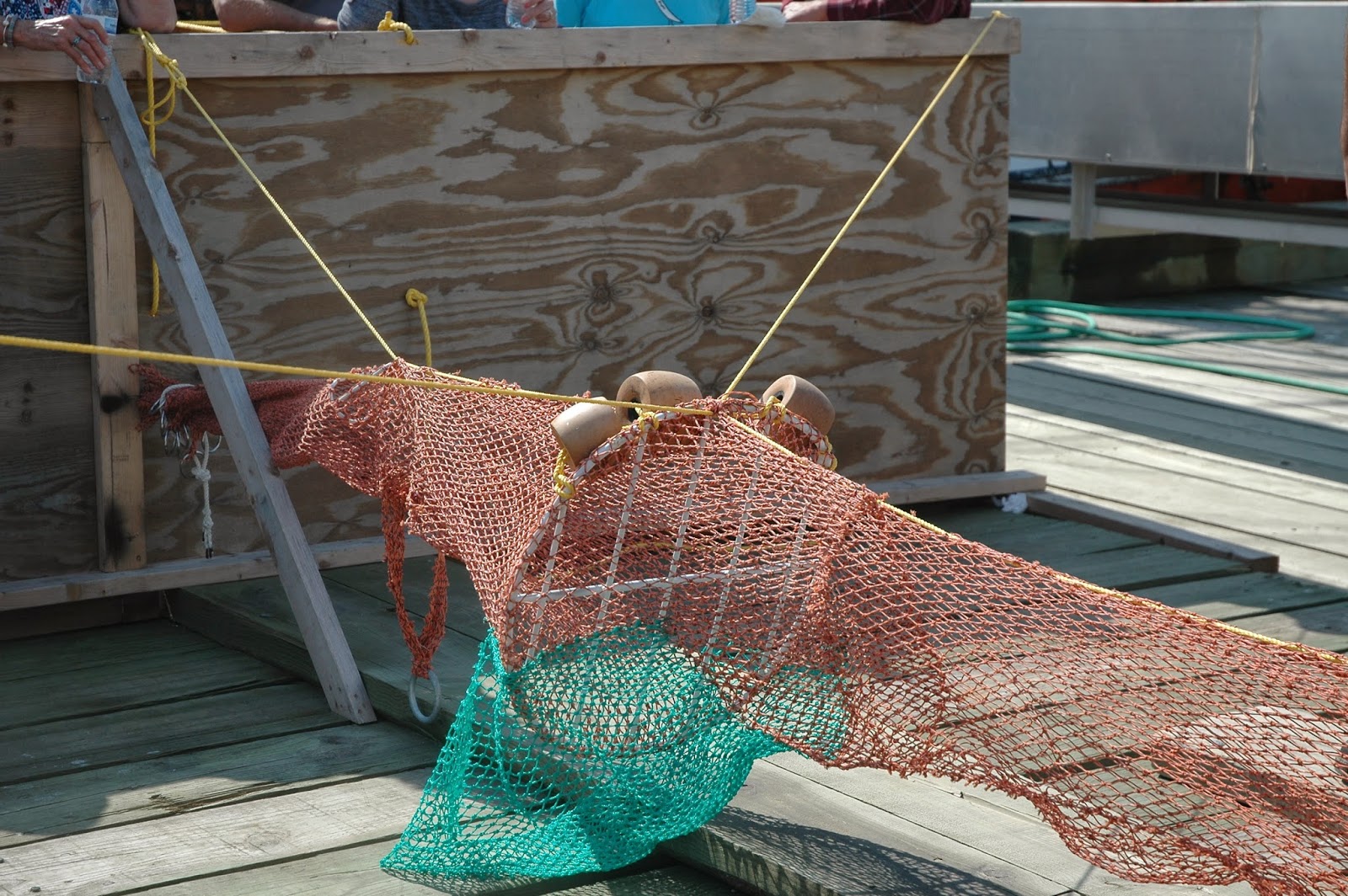
A small model of the shrimp net was staked out on the deck and it was explained how the process works.  The wide end is attached to heavy side boards that, with the aid of water pressure, hold the mouth of the net open.  At several spots along the net, there are escape hatches that enable critters, other than shrimp, to escape.  The shrimp are funneled into the tiny closed end of the net. 


When the nets are brought up, the knotted rope at the top is open, spilling all the catch onto the deck of the boat.  The knot is retied and the rig goes back into the water for another four hours of trolling.

The group moved onto the deck of the boat to hear about what kind of jobs are performed on a shrimp boat that is at sea for 60 to 90 days at a time.  As soon as the nets are back in the water, the "headers", as the crew are called,  begin de-heading all the catch that was dumped onto the deck.  This is done, using the thumbs of both hands, to pop the heads off the shrimp. A tricky task because the little devils have a sharp barb on their heads that can pierce gloves and skin. The men sit on a short stool with their legs out straight, for four hours at a time. 

The de-headed shrimp are gathered into a bucked, then placed in plastic mesh-like storage boxes.  These boxes, measuring about 20" X 30" X four inches deep, are submerged in a solution of 32 degree water containing a mix of salt and a preservative, which coats the shrimp with ice, allowing the catch to be individually frozen.  The trays are then placed in the boat's freezer. 

Crew quarters on the boat


The Texas Gold Shrimp company hires the captains, who in turn, hire their own crew.  When the boats come back to port, the captain is paid for the shrimp he brings in, then he divides it among the crew.


Part two of the tour shuffles the group back to the building, where we learn the facts about "Country of Origin" labeling, (which has enough loopholes to sail a trawler through), the percentages of wild-caught, vs farm raised shrimp, and the chemicals and antibiotics used in farm raised shrimp.  There was a video, taken at the processing plant where the shrimp are sorted, sized and checked for quality control.   Our host indicated that people who are allergic to shrimp are most likely allergic to the chemicals and the heavy doses of antibiotics used when shrimp are farm raised.  Most of this technical information is available on their web site texasgoldshrimp.com. 


Now the fun part begins.  After showing the correct method of de-shelling a shrimp, a contest for the fastest sheller was begun.


Not a fair fight.  He choose a senior, and one of the only under 50's in the group.  Guess who won?

Then we all got a chance to give it a try.


Even Marlin gave it a try.


Now you  know everything you ever wanted to know about shrimp harvesting.

Tuesday, February 10, 2015

Winter Texan Appreciation Day

Throughout the months of January, February and March many of the Parks, Cities, Sanctuaries, and Nature Centers in the Rio Grande Valley hold Winter Texan Appreciation Days. Each event is different but they are all aimed at letting the people, who come here during the winter months, know that their visits are indeed valued and encouraged.

The event at Resaca de la Palma, held on Friday, February 6, was a very successful and fun day.  


 Barbara, a new volunteer, greeted people and gave out information about the days events and about regularly occurring programs held at the park each week.


Visitors began arriving shortly after 8:00

Hot coffee, tea, cocoa, sweet breads, and fruit were available all morning


Jan directed everyone to the different activities that repeated all day.  Today was an abbreviated showcase of the regular programs the park holds each week.

Marlin and Albert headed out with a group for a shortened version of the nature hike


Sherry took a large group for a bird walk down Ebony trail.  Ebony is the shortest trail in the Park and is located right next to the visitors center.  There are two resaca overlooks on this trail, as well a signs marking notable trees and plants.  Bug spray is a necessity though.

Steve presented a slide show and information about the park in the meeting room.  People could come in at any time during their stay and watch the show, while they ate their breakfast or lunch, that was provided by the Park


Gloria, on the right, demonstrated how geocacheing works.  This Park has 13 caches scattered throughout the trail system. The Park has several hand-held GPS units that can be used by visitors.  There is also a phone app that can be downloaded on smart phones that is easy to use.  The next day, Marlin and I located two of the caches using our new phone app.  Can't wait to find all 13.  By then I should know the process well enough to entice my grandchildren into coming with me to find some near home in Maine.  Gloria also leads the Saturday yoga program, but that was not demonstrated today.


Richard drove the tram on the Park loop road every half-hour for people to get a general idea of where and how many walking/biking trails are available to explore.  Sherry is telling him there is a group ready to board the tram.


Cynthia manned the front desk.  Since it was free admission today, she only had to keep up with the gift shop.  Many compliments about the selection in the shop.

Marlin and I prepared and served a lunch of hot dogs, cookies, brownies, and bottled water.  We did not have a chance to take any pictures of each other or of folks enjoying the goodies.


This armadillo wandered around the visitors center most of the day.  He was a real treat for most Northerners to see.  There has been extra rain this past month, and these critters love to dig in the soft soil near the building for grubs.


Tuesday, February 3, 2015

Santa Ana National Wildlife Sancatury

 Kathy Whittier, who we met last year while we were working at Bentsen State Park, organizes multiple birding trips for her RV park. Again this year she continues to keep us informed of the where and when of these trips.  We go whenever we can because she is an extremely knowledgeable birder and the group is always fun.  On January 30th we met the group at Santa Anna National Wildlife Refuge. Santa Ana is one of the many extraordinary areas containing salvaged or reestablished habitat along the Rio Grande River in the most southern tip of Texas.


We joined the  14 people from Bentsen Palm RV park at 8:30 for a guided bird walk.

Beautiful trails


Lots to see in addition to birds


This ball moss epiphite is similar to the better known Spanish moss that hangs off trees in most climates, and only uses the trees for a resting place.  They actually are "air plants"  and get nutrients from the microbes in the air.

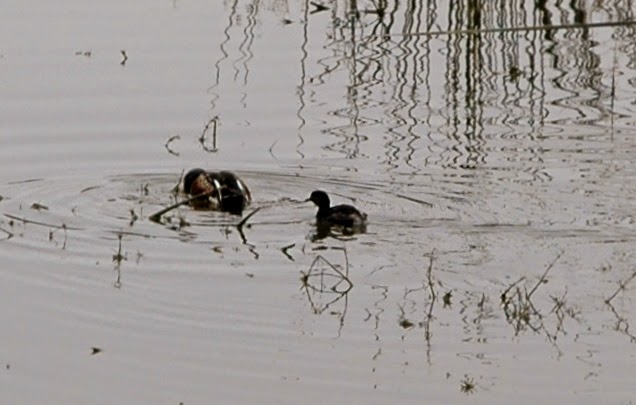
Many varieties of ducks and water birds were seen in the first resaca we stopped at.  This little Least Grebe is following a Shoveler duck.  The Shoveler dives down, stirring up food for himself, then the little Grebe gobbles up whatever the bigger duck misses, eating without all the work.

Kathy always keeps track of every bird seen and reports the list on ebird when she returns.  There is a feature on ebird that lets all those who were with her to add the list to their own ebird page.  It is kind of like the Shoveler and the Least Grebe.  She does all the work and we get to add to our lists!

What was that bird?

After the bird walk and a picnic lunch, we boarded the tram for a seven mile tour of the park roads.  The tram makes one stop at an old cemetery on the Sanctuary property


Back in 1834 this land was a Spanish land grant given to a man named Benigno Leal.  The cemetery was for his family and those who worked on the ranch.  In 1848, after the war with Mexico, the land on this side of the Rio Grande river was ceded to the United States. The Leal family slowly sold off their land after it became part of the US.  However, Cristoval Leal, the only son of Benigno, was buried here in 1876.  His is the large monument on the right.

 The post fence around the cemetery is made of Texas ebony.  These posts have been weathering for over 100 years and are still standing.


Texas windmill grass is native to this area but has been almost choked out by non-native grasses that have been imported by ranchers for cattle to graze.


Observation towers connected by a swinging bridge.  When we were here last year during a cold snap we had on our winter jackets, hats, and scarfs.  Much nicer today.


Got a good look at two Harris Hawks on our way out of the park.  These hawks are quite common in the south Texas area.  They usually hunt in pairs or small groups, so you seldom see a loner.  Wish the picture was better.  They are a deep brown with bold redish shoulder.stripes.