Wednesday, September 20, 2017

Back road weekend wanderings

For the weekend, fishing was put on hold and we wandered along some of the back roads. This favorite activity of ours always produces something of interest.  Operating with only my phone camera, since my Nikon has decided to revert to an unexplained error message again, the pictures are less than great, but better than I expected.


 Being without my camera was especially painful because there were dozens and dozens and DOZENS of Mountain bluebirds flying everywhere and on every fence post.  I even tried putting the phone camera lens onto the  binoculars.  This is all I could produce but not bad for the technique.


We saw some herds of wild horses in the distance.  (Same technique-through the binoculars)


Lots of untold stories in the abandoned buildings along this dirt byway.


What happened to the family that occupied this home?  Why did they leave and where did they go?


Looks like the foundation was hand made from local rocks. These deserted dwellings make me think that for all our efforts, we really are only ashes to ashes, after a very short time here on earth.

The gravel road we were on ended at Route 24 and a tiny village called Hartsel.  What a fun eclectic collection of buildings clustered here.

 .
The local school


The library


A local, active, and busy garage, complete with cars being worked on in the driveway


The corner Saloon and grocery store


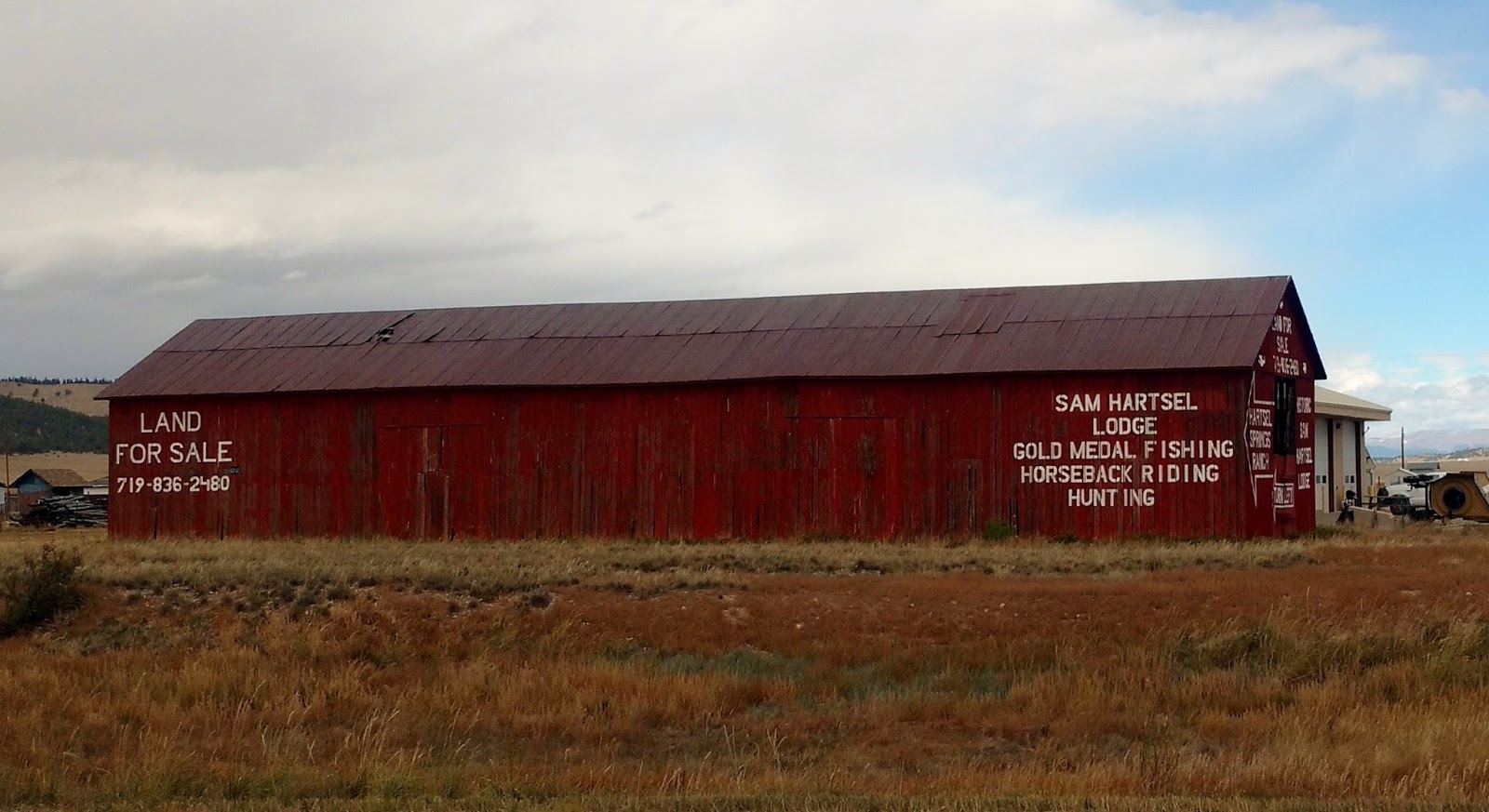
Great way to advertise.


Not sure if this is for real or a joke


The return trip on Highway 24 took us over Wilkerson Pass at 9,507 feet


I believe that is Pikes Peak in the background.


Splashes of gold all along the road


We spent the weekend in a non-electric site because- again- electric sites were all reserved.  Not bad, but it is back to electric hookup on Sunday night.

Monday, September 18, 2017

Eleven Mile State Park, Colorado


Leaving Nebraska behind, our intention was to visit Rocky Mountain National Park in Estes, Colorado.  Our last visit to that park was in the late 60's as we traveled from California toward Massachusetts, meeting my parents at a campground there for a few days.  I was anxious to relive that episode as well as marvel at how the park had changed over the intervening years.  Not to be.  Every camping spot we called, within a 75 mile radius, was full. Who knew September would be such a popular camping time.   The next stop on our list took us straight into the mountains west of Colorado Springs.

Several years ago we stumbled onto Eleven Mile State Park, found the fishing and hiking superb, the campground nearly empty, and the big sky setting spectacular.   This trip we had to stay at an RV park for the weekend, because all the sites at Eleven Mile were full. There was a fishing derby being held at the lake and families were getting their kids outdoors.  Seems Colorado camping is very popular in September

Monday morning this was our  campsite at Eleven Mile State Park, Colorado


Eleven Mile is one of Colorado's largest reservoirs, located within in a high alpine meadow at an elevation of 8,600 feet.


Not many trees, but lots of sweeping vistas, with the high Rocky Mountains in the distance.


The best part of camping is cooking and eating outside.  Sometime a bit tricky finishing your meal before the wind cools it off.


It may be the time of year, but the sunsets have been brilliant.


When we arrived, a friend asked if the Aspens had begun to turn yet.  I had not seen any at that time but within a few days, gold began to show up on hillsides.


A little here, a little there.


By the second week the brilliant yellow and gold was everywhere.


This is an area of Colorado called South Park.  South Park was a favorite trapping spot for Mountain men in the 1820's until the 1840's when beaver hats fell out of favor.  Several notable men, who not only trapped beaver, but extensively explored the west, were Kit Carson, Joseph Meek, John Smith and Dick Wootton.  I only know about this because of Marlin's long term interest in these men and the Mountain Man era.  They called these valleys "Valle Salado" for the salt flats used by tribes of Ute and other native groups.


Today the major attraction seems to be fishing.  There are several sections of the South Platte River where trout are abundant, pieces of the river are open to the public access, and, under State ownership, are protected from development. These are known as "Gold Metal" waters.


One such section contains a dedication to a man called Charlie Meyers, a sports writer and avid outdoors man, who wrote for the Denver Post. He actively championed making the "Dream Stream" between Eleven Mile and Spiney Dam, open for public access.


The South Platte River "Dream Stream". This is the view I enjoy.


But, This is why Marlin is here.  Glad he brought me along.


Different day, same activity


After a full week of fishing these bountiful waters, it was decided to follow it up with a second week of chasing trout.  I told Marlin to take advantage of this time and place because he probably would not return here again.  Now I am not so sure of that.

Friday, September 8, 2017

Bailey train yard, North Platte, Nebraska

At a roadside rest stop Marlin picked up a brochure about Union Pacific Railroad's Bailey Yard, "the largest classification yard in the world".  Who could pass that by!

The Golden Spike Tower is the place where you can get a panoramic view of the rail yard.


To be honest, I was not sure what a "classification yard" was, but it sounded interesting and the tower looked cool.


The Visitors Center video explaining the "classification yard" concept left me still unclear.  I did get that this is where trains are put together, which cars go where, with what engine.  The brochure explains it as "..simply a switch yard where trains enter, are taken apart and sorted, then sent out to new destinations".  That doesn't begin to describe what happens at this yard.

First off the statistics are boggling. The yard covers over 2,800 acres with a length of 8 miles and 315 miles of track.  Eighteen million gallons of fuel, each month, goes into the trains stopping at the yard. Union Pacific employs 2,600 people in North Platte, working either in the yard and shops or operating over-the-road trains.  There are 10,000 rail cars through the yard every day, with 3000 of those cars being sorted onto different trains and tracks.


It was impossible to get pictures to clearly illustrate what the yard is all about.  Below you can almost make out a raised track, slightly left of center, to the left of the smoke.  This is called the east bound "hump"  There are two separate yards, an eastbound and a westbound.


The hump is actually a mound of 34 feet high for eastbound and 20 feet for westbound. When a train is 20 miles away, a computer reads a chip on the car that identifies where they are coming from and where they are going.

This information is correlated in the command center  If a car needs sorting, the command center directs it to the correct "hump", where it is pushed to the top by a switch engine. Gravity then pulls the car down,  its speed is electronically controlled so that it arrives at its destination moving at exactly 4 miles per hour so it does not damage the car it is coupling with.

As it is descending the hump, one of  985 switches then divert the car to the correct train on the right track. This amazing  process is all initiated by computer at a control center in the heart of the yard.


Below is an illustration of the yard layout, with the westbound yard on the top and the eastbound yard on the bottom.


Most of the trains that come through have all the cars going to the same place and  do not need to have any cars sorted, or changed to different engines. They are serviced and refueled quickly and go on their way.  An average day sees 300 locomotives serviced.


This is the locomotive repair shop.  Employees repair 750 locomotives each month.  There are eleven tracks with elevated service bays and remote controlled overhead cranes. The building is as large as three football fields.


The long line in the background shows some of the eight miles included within the yard.


There was a docent at the top of the tower pointing out what was happening with all the trains that were moving around within our view.  His explanations helped put all the pieces together, somewhat.  I think I would need several more visits to really understand how it worked. Well worth a stop here if you are anywhere near North Platte, Nebraska.  You should skip the gallbladder removal part.

 Quite a marvel of modern technology, and something to add to my motto of learning something new every day.

Tuesday, September 5, 2017

Sandhill Crane Trust


Five days of recovery from Marlin's unexpected adventure, allowed enough energy for an afternoon of tourist activity.  We learned about the nearby Crane Trust Nature Center.  The Crane Trust, was established in 1978 as part of an agreement negotiated between interested parties when the Grayrocks Dam in Wyoming was proposed and constructed.  Their mission is to provide leading scientific research, manage critical habitat for cranes and other migratory birds, and to advance outreach and education.


 Nebraska is a critical staging area for birds migrating on the Central flyway, especially Sandhill and Whooping cranes.  These large birds use the shallow waters of the Platte River, nearby corn fields, and open meadows to feed and roost before continuing their journey to Canada, Alaska, and even Siberia.  Every spring, from the end of February through the first part of April, over 500,000 Sandhill Cranes, and  small flocks of Whooping cranes stop to replenish their energy and strength before continuing their journey.  Eighty percent of all Sandhill cranes stop on the Platte River during spring migration.


A beautiful building that greets you outside with the sound of honking cranes.


The cranes use the shallow waters of the Platte to roost at night, where they are protected from predators. The braided channels that flow around sandbars make ideal places for the large concentrations of birds.  Cranes usually travel in small family groups, but while they are here on the Platte, they intermingle with many other groups.

 Most of the day, cranes spend in in the fields and meadows near the river.  They feed on corn left in the field after harvesting, plant tubers in the wet meadows, and snails, earthworms and insects that come to the surface in the wet spring fields.


The walking trails at the Crane Trust include viewing towers and bridges that cross the river and side channels.  I can only imagine what this looks like with 10,000 cranes roosting along this stretch of river.  I bet there are also that many viewers.

Whooping cranes are one of the rarest and most endangered birds in North America.  There are approximately only 300 in the wild migratory flock.  Whooping cranes use the Platte River to stop, feed, and recover in the wet meadows.  They will spend 2 to 3 days here before continuing their migration.  A few whooping cranes have spent more than a month in this area.  These are usually individuals that migrate with flocks of sandhill cranes.


As part of their mission to research Platte River habitat, the Crane Trust has established a bison herd. In 2015 the  Crane Trust acquired a herd of 75 genetically-pure bison.  Historically large herds of bison migrated throughout the planes. The bison graze on native grasses and disturb the soil with hooves, which allows other plant and animal species to grow.   The Trust is monitoring, through long term studies, how their addition to the ecosystem can  benefit the habitat for cranes and other birds.


We were lucky enough to see about 40 of the herd resting near one of the trails, especially since they have 10,000 acres to roam.


Being here at the Platte River in March must be an extremely exciting event.  Make your reservation now!


Friday, September 1, 2017

Unexpected adventures

Picture Nebraska.  Hundreds of miles of corn and soybean fields, occasional off ramps with no towns in sight, even off ramps to larger cities like Grand Island.

On Monday, August 28th, after a breakfast with Uncle Bill and Lisa,  Mike, Marlin, and I drove to Des Moines where Mike picked up a rental car and headed to southern Iowa for a visit with High School friends.  Our first night's stop landed us in the Walnut Creek Recreation Area in Papillion, Nebraska, where we enjoyed a long walk around the reservoir.  All was fine until four AM the next morning, when Marlin woke with sharp and constant pain in his abdomen.

Confident it would pass, we continued west on highway 80.  Along about noon, when it was apparent the pain would not abate, we found a KOA just outside Grand Island.  The nearby walk-in clinic sent us directly to the emergency room at St Francis hospital where they quickly and efficiently diagnosed pancreatitis and admitted him at about five PM.


St Francis Hospital , Grand Island, Nebraska.


To our amazement, within an hour, the surgeon came by and explained that his gallbladder was causing the problem and needed to be removed.  He could do it first things in the morning!  At first Marlin wanted to put it off till we returned home, but the next morning his lab work showed that in spite of the medication they were giving him, the problem was increasing instead of abating.   They put him on the schedule for 11:00 AM.


This is a visitors waiting room on his floor.  He was actually on the pediatric floor, but they place surgery patients there when they have extra rooms.

His room was large, private, a sleeping couch for spouses, and had a great view


Nice large bathroom

Before Marlin went down to surgery, his nurse told him there was a recovery nurse that was from New England and she was excited to have someone from the East here at St. Francis.  She called anyone from the east, "My People".

While I was sitting in the surgery waiting room she came out because Marlin had told her that his wife grew up in Randolph, Massachusetts.  She wanted to meet me because she also grew up in Randolph, Mass!   We had a great time talking about Lynwood pizza, Zeppy's bakery, etc.  You have to say "Small World" with capital letters.


Post Op.  Not with it.


After a shower the next morning.  Somewhat with it, but not totally.

The staff at this hospital was delightful.  Everyone that came into the room introduced themselves and shook our hand.  We never felt like anyone was in a great rush to move on to other duties, and everyone on the floor knew we were travelers stranded here by circumstance.  It was a totally pleasant experience. (Except for the illness)

By Friday, two days after surgery, we walked around the campground for about 30 minutes.  Improving by the minute.  This will be an adventure we remember for a long time and "Nebraska" will never have the same meaning in the future..


Wednesday, August 30, 2017

Other Moline attractions


Between visits with relative and friends, a few local points of interest were squeezed into the week.  A few extra hours on Friday morning left time for a visit to the Rock Island Arsenal Museum.  The Rock Island Arsenal is the largest government-owned weapons manufacturing arsenal in the US,  It has been manufacturing military equipment and weapons since 1880.  Located on an island in the middle of the Mississippi River, it was originally established as Fort Armstrong in 1816.

The museum on the arsenal is nationally recognized for its impressive arms collection, numbering more than 1,100 firearms used by the military, as well as other foreign, civilian and military. The collection includes at least four weapons that were used by the Sioux or Cheyenne at the Battle of Little Bighorn.


In addition to this wall, the display cabinets continue the length of the back wall.  Twenty five percent of the collections small firearms are not on display.  Each section is color coded so you can identify the time period and origin of each gun.  Signs along the bottom note significant items.                     


During the Civil War a total of 1,964 Confederate prisoners were housed at the Rock Island Arsenal.  Mike is an avid Civil War buff and he knew some of the history connected with this chapter of the war.  According to Mike, there was a unit of soldiers who were "older"than most of the troops.  After one battle assignment, they were transferred to Rock Island to be prisoner guards.  This unit was nicknamed "The Gray Beards".  Today there is a small display regarding the prisoner camp that included some pictures of the compound.  According to Mike there used to be a large, complete diorama of the prison building complex.Today the only diorama is a layout of the arsenal buildings with pictures of their construction.                                                                                                       


Current diorama and pictures of the building construction in 1832


This is how they appear today


Buried in the military cemetery on Rock Island are 1,964 Confederate prisoners, 125 Union guards, including 49 members of the United States Colored troops, who also served as guards .  Most died from disease, since sanitation was primitive, heat and humidity were high during the summers, and temperatures during winters were freezing.  Also, in 1864 a deadly small pox epidemic raged through the prison.                                                                                                                                               


A trip to Western Township Cemetery for a visit with Maynard, Georgia, and Maynie Cook was sad but brought out many good memories of all three.  Marlin shared some childhood stories with Mike about when he and Maynie were young and lived here in Moline, Illinois.  Mike was only 9 when his Dad was killed in a car accident.                                                                                                         


On Saturday morning we managed a short bike ride on the path that runs for 60 miles along the Mississippi River.   In the town of Hampden we rode past the Brettun and Black building museum and stopped in for a quick look.  


One of the Historical society members was outside carving Black Walnuts into eagles.  We chatted with him for awhile and he gave us one to put on our Christmas tree.


Inside we talked with a member who gave us the information about the restoration of the building.  It all sounded very familiar!  Years of work by a few dedicated members.  The building was originally used as a pork packing warehouse, and later as an apple packing facility.  This reconstructed, hand operated dumb waiter brought barrels of apples from the lower floor to the top floor where they were pressed into cider.  


The other event we managed to fit in was  of course "The Wedding"


Beautiful setting for the ceremony


The reception tent


And of course, The Bride and Groom;  Will and Brittney Tolmie


Mother of the Groom, Candy Tolmie


Not a great picture of Bill Tolmie, farther of the Groom

And more relatives!


Linda and Tom Sharp


Candy's sister Maggi, with her daughter Kathi and grandsons Nick and Ty.  A great ending to a great week in Illinois.