Tuesday, February 3, 2015

Santa Ana National Wildlife Sancatury

 Kathy Whittier, who we met last year while we were working at Bentsen State Park, organizes multiple birding trips for her RV park. Again this year she continues to keep us informed of the where and when of these trips.  We go whenever we can because she is an extremely knowledgeable birder and the group is always fun.  On January 30th we met the group at Santa Anna National Wildlife Refuge. Santa Ana is one of the many extraordinary areas containing salvaged or reestablished habitat along the Rio Grande River in the most southern tip of Texas.


We joined the  14 people from Bentsen Palm RV park at 8:30 for a guided bird walk.

Beautiful trails


Lots to see in addition to birds


This ball moss epiphite is similar to the better known Spanish moss that hangs off trees in most climates, and only uses the trees for a resting place.  They actually are "air plants"  and get nutrients from the microbes in the air.

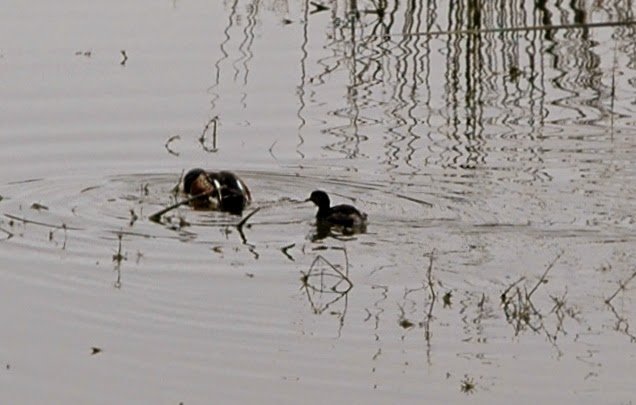
Many varieties of ducks and water birds were seen in the first resaca we stopped at.  This little Least Grebe is following a Shoveler duck.  The Shoveler dives down, stirring up food for himself, then the little Grebe gobbles up whatever the bigger duck misses, eating without all the work.

Kathy always keeps track of every bird seen and reports the list on ebird when she returns.  There is a feature on ebird that lets all those who were with her to add the list to their own ebird page.  It is kind of like the Shoveler and the Least Grebe.  She does all the work and we get to add to our lists!

What was that bird?

After the bird walk and a picnic lunch, we boarded the tram for a seven mile tour of the park roads.  The tram makes one stop at an old cemetery on the Sanctuary property


Back in 1834 this land was a Spanish land grant given to a man named Benigno Leal.  The cemetery was for his family and those who worked on the ranch.  In 1848, after the war with Mexico, the land on this side of the Rio Grande river was ceded to the United States. The Leal family slowly sold off their land after it became part of the US.  However, Cristoval Leal, the only son of Benigno, was buried here in 1876.  His is the large monument on the right.

 The post fence around the cemetery is made of Texas ebony.  These posts have been weathering for over 100 years and are still standing.


Texas windmill grass is native to this area but has been almost choked out by non-native grasses that have been imported by ranchers for cattle to graze.


Observation towers connected by a swinging bridge.  When we were here last year during a cold snap we had on our winter jackets, hats, and scarfs.  Much nicer today.


Got a good look at two Harris Hawks on our way out of the park.  These hawks are quite common in the south Texas area.  They usually hunt in pairs or small groups, so you seldom see a loner.  Wish the picture was better.  They are a deep brown with bold redish shoulder.stripes.

Tuesday, January 27, 2015

City of Brownsville Museum and Narrow Gage RR Engine

Our co-host volunteers, Jan and Steve Mondl, invited us to join them for a guided tour of the Old Brownsville Cemetery.  Sounded like fun, so we booked the next tour, which was on Friday, January 23.  That day turned out to be rainy and cold, so we opted to visit the City of Brownsville Museum next door instead.  Turned out to be a good choice and we learned a good deal about Brownsville's beginnings.

 The museum is located in the old Southern Pacific train station.  Quite an attraction in and of itself

Steve and Marlin outside the museum

A  man called Simon Celaya, originally born in Spain, organized the Rio Grande Railroad between Brownsville and Port Isabel in 1870.  Passengers would arrive in Port Isabel on steamships and would transfer to the train cars, that were backed up to the dock, for a short two hour trip to Brownsville.  The railroad was build on pilings that crossed the shallow lagoons that existed between the two cities.


The station baggage room now contains the bed in which Simon Celaya died in 1908.  The docent in the visitors center claims the room has a history of strange occurrences, enough so that "ghostbuster" type teams have come to check out the room. This seems unconvincing, since the station was not built until 1927, long after Mr. Celaya's demise, as well as the Rio Grande Railroad, which had become part of the Southern Pacific Railroad.

The museum held many interesting artifacts from Brownsville's history but the highlight of the tour was the restored, 1877, narrow gage railroad engine #1.


We were lucky enough to be leaving the museum when the gentleman who had restored the train came in to drop off some pictures.  His name is Gene Balch and he is a retired machinist who owns the machine shop where the work was completed.  He did the renovation for free, having his employees work on the train when there was a lull in the work schedule.

 He was naturally very interested to tell us all about the process, how things were repaired, or replaced, and how long the process took.  He had some pictures of the train when it was located and I could not believe it was possible to reconstruct it from the condition of the body.  When the repairs were about half complete, he asked where the city was going to put the train when it was finished.  A city official described an outside location, near the water.  Mr. Balch told the man "If that is where this train is going to be located I am going to stop right now."  He figured if it was left out side near the water it would not last very long.  Fortunately funds were raised for a new building, next to the old station, where  the train is now permanently located in a temperature controlled environment. 


 The train was lifted into the building before the roof was put on. The interior is nicely finished with many display cabinets containing pictures and artifacts relating to Brownsville's railroad history. 


Monday, January 26, 2015

Visits with old friends

Blog posting has been sorely neglected lately.  Marlin was fighting a nasty cold for a couple of weeks and I did not take pictures, or very many, on some of our trips.  However, I do have some to post.

On January the 16th we traveled back to Mission for a visit with Ken and Terry Smeltzer.  We met Ken and Terry two years ago while we were in Austin for a week.  They introduced us to some of the nightly music venues in the City that year, and last year they traveled down to Mission to visit us at Bentsen State Park where we were volunteering.  They liked that area so well, that this year they are staying in an RV park on the road to Bentsen.

 Here we have the senior "Blues Brothers"


This was the first sunny day we had had in about two weeks.  After visiting some of the attractions around Mission and a quick lunch at Marco's, we ended the day at Rancho el Chaco for a relaxing beer and good music.  This is actually a wild-life ranch where you can take a wagon tour through the extensive grounds and view an assortment of animals, including some buffalo.  During the weekend evenings they have live music and a full menu at the restaurant.  Today they were just serving beer, but we enjoyed sitting outside overlooking the man made lake.

The next evening, we met David and Selene Rodriguez  for dinner at a local Barbeque restaurant .  David is a Ranger at Bentsen State Park where we volunteered with last year.  Before our job here at Resaca de la Palma began, we stopped in to visit at Bentsen and touch bases with the crew we had worked with at that park.  When we talked with David that day, we made plans to meet for dinner one night.  David posted this picture on facebook shortly after we met at the Longhorn Restaurant and Barbeque in San Benito.

 David's wife Selene, is undergoing treatment for breast cancer.  I was incredibly impressed with her positive attitude about the entire process thus far.  Fortunately, she has been able to continue working as a Speech Pathologist three weeks out of the month, being down- and-out for only one week after each chemo treatment.  She has such a upbeat outlook on the outcome it was easy to talk with her about how she was getting through the process.  With two preschoolers at home, it is hard to express how impressed I was with this young woman.


Great picture of David and Marlin that night.

A week or so later, Ken and Terry drove down to Resaca de la Palma and we all headed for South Padre Island for the day.  In one of those "small world"  occurrences, Terry was talking about their visit to Louisiana before heading down to Texas.  She had been doing some genealogy research on Ken's family and discovered that his Great-Great Grandfather had died from dysentery at Palmito Ranch in Brownsville, Texas. This was the place where the last battle of the Civil War was fought and the same place we  discovered the historic marker and posted about earlier this month.


After the battle, all the bodies at that site were moved to Louisiana. We stopped by the marker so they could get a couple of pictures to go with their records. 

Ken and Terry brought along another nice day.  We spent the day checking out the boardwalks at the South Padre  Chamber of Commerece which provide a view of the Laguna Madre, (inter-coastal waterway) and then walking on the beautiful Gulf side beach.

This Redish Egret posed nicely, close to the boardwalk, in the marsh.

Looking out to Laguna Madre


 Public Access to the Gulf-side beach


Several fishermen out in the water.


While we were  walking on the beach, Clayton's Beach Bar was providing live music on the outside patio


We got a seat overlooking the beach and watched the fun below as the sun went slowly down into the sea


I'm sure those girls were chilly, but it was fun to watch those young beautiful bodies chasing that ball with no effort at all!

Friday, January 9, 2015

Kings Day, "Dia de Reyes" January 6

An unexpected treat at work on Tuesday, January 6th.  When I came in at 8:00 there was a large box containing a fancy looking bread.  Shortly after 8:30 all the other park staff began to filter into the back office.  The pictures are poor phone quality.  I did not expect to need my camera today.


Steve Mondel, one of the six park hosts, was in the kitchen making "Abuelita", traditional Mexican hot chocolate


When the hot chocolate was done and everyone had a cup, complete with whipped cream, we learned the story about this local celebration.  Pablo, the Park Superintendent, explained why January 6 is an important Mexican tradition.


The day is called Dia de Reyes, Three Kings Day.  The legend reports that six days after the birth of Jesus three wise-men arrived in Bethlehem with gifts for  baby Jesus.  They had followed the star from their kingdoms far away. Today, many Spanish speaking families celebrate this as their Christmas when gifts are exchanged. Part of the giving tradition includes a sweet bread, shaped in a circle like a kings crown.  Inside this traditional "Kings bread"  are hidden tiny baby figurines.  The hidden figurines are symbolic of the fact that Jesus was hidden in a stable from King Harod's solders who were sent to kill all recently born male children.Today's bread contained four, we were told.  Anyone who finds a baby in their piece receives the privileged of giving a party, called "Rosca de Reyes" on February 2.


Albert cuts the first piece while Cynthia looks on.  First piece, the very first baby, which means he must be the host for a party on February 2th.


Stephanie and Sherry,


Lauren and Jan,


Marlin, Dick, and Carlos are all glad they did not have to plan the next party.   Wait---Marlin did get a baby.  Guess he needs to practice making enchiladas!  This is going to be a fun place to work for three months, if only the sun would come out.

Sunday, January 4, 2015

Boca Chica Beach

Although I was actually missing "Yoga in the Park" yesterday, I was anxious to use the day off to visit a new area in this lower Rio Grande Valley.  We headed out to Boca Chica Beach, located at the southern-most tip of land on the Texas side of the Gulf of Mexico. Route 4, out of Brownsville covers about 15 miles of marshy ground, posted as National Wildlife areas.  This stretch of land also has some interesting history.  You never know what you are going to find out about when you stop and read every Historical Marker along the highway, which is one of Marlin's favorite activities.  Who knew that the very last battle of the Civil War was fought in Texas.


Even though Lee had surrendered more than a month before this May 12, 1865 battle, the Colonel in charge of the Union troops ordered an attack on Confederate troops stationed in Brownsville.  This confrontation ended in a Confederate win when Union troops fled back to the coast.  Makes you wonder how "the rest of the story" played out.  Further along, another marker described the cypress post remains of a railroad built by Zachary Taylor in 1846 to move supplies during the war with Mexico.

At the beach it was cold and windy but we headed out for a walk anyway.  Vehicles are allowed on this beach and the only people we saw were inside cars or trucks.

Boca Chica Beach


Not as many shore birds as we would like to have seen but the walk was very enjoyable.  We will definitely come back here often.


One cold Heron.  He/she let me walk very close before taking flight.


Miles of beach.


and dunes


Only a few scattered birds were to be seen


On the ride back through the tidal marsh we got one more treat.  A Harris hawk sat on a fence post for at least five minutes, eating the lunch of a nice fat mouse he caught on the dunes.


So far we are seeing a great selection of hawks in this area.  Hopefully I can get some good pictures when I remember to bring the tripod.